

Procrastination, anxiety and motivation: why do we put tasks off until the last moment?
“I can only be productive when the deadline is close.” It is a very common phrase. And when a deadline is looming, concentration does seem to appear and the work gets done. But does this mean we work better under pressure, or simply that we only manage to start when we feel a sense of urgency?
What pressure actually does
As a deadline approaches, the body may activate its stress response, increasing alertness and mobilising resources to meet the demand. Activation of the sympathetic nervous system and the release of substances such as adrenaline and noradrenaline help prepare the body for action.
The urgency of finishing a task may temporarily reduce the attention given to other activities, making that task the priority. The relief felt after completing it can be so strong that it reinforces the idea that working under pressure “works”.
However, managing to finish a task does not necessarily mean that performance was better. Often the result is sufficient, but it could have been more thorough, organised or carefully reviewed if there had been more time.
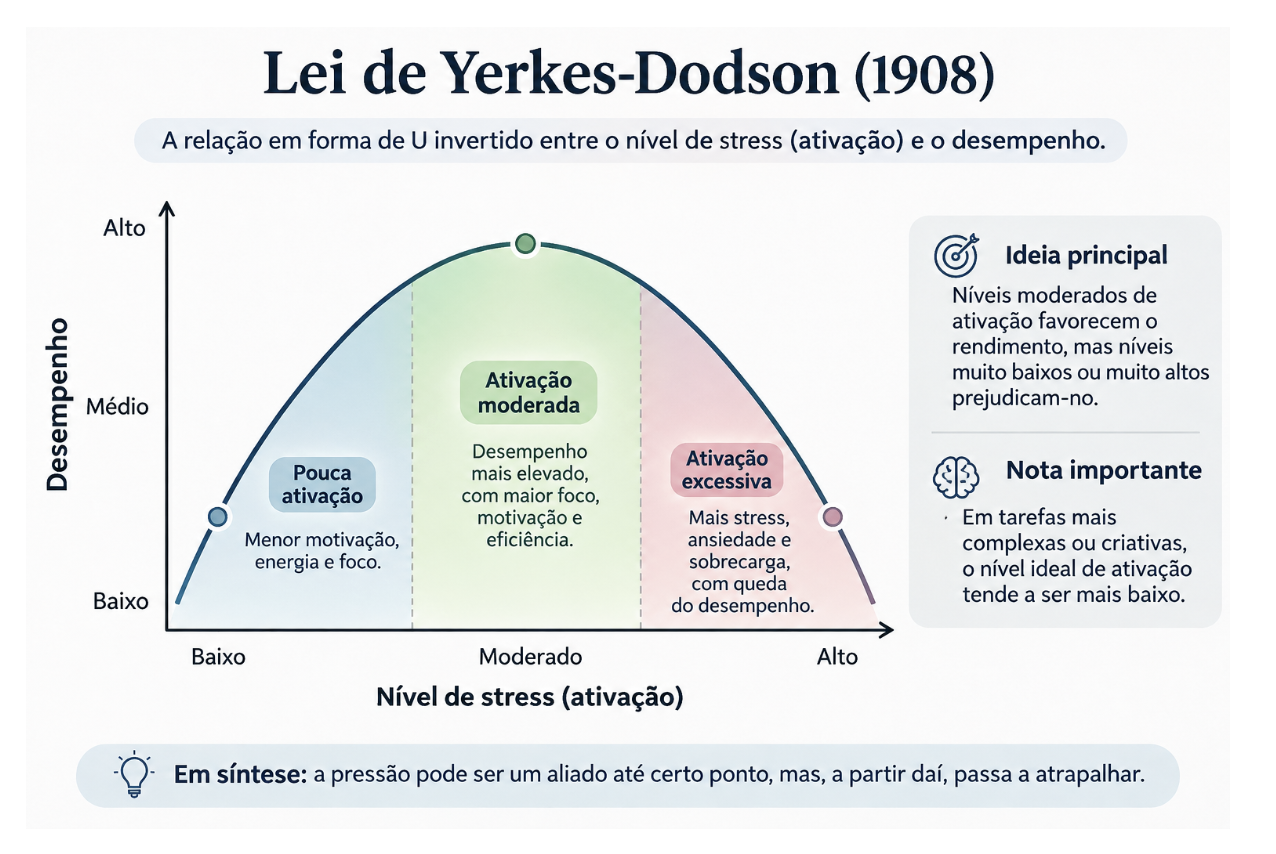
This relationship between arousal and performance is often illustrated by the so-called Yerkes–Dodson law (1908). The original study investigated learning in mice, rather than professional performance under deadlines. The familiar inverted-U curve is a simplified representation: the effect of arousal depends on the task, the person and the context, and there is no single optimal level of stress for everyone.
In other words, urgency may increase readiness to tackle a task, but it does not guarantee better performance. Excessive pressure can make work harder, particularly when the task requires concentration and reasoning.
Why do we leave everything until the last minute?
Procrastination does not necessarily stem from laziness or a lack of willingness. It may be related to different psychological mechanisms:
Present bias. We tend to give greater weight to immediate rewards and relief than to future benefits. According to Temporal Motivation Theory (Steel & König, 2006), the more distant a reward or deadline is, the less motivational weight it tends to have in the present. As the deadline approaches, urgency increases and the task becomes a priority. Hence the feeling that motivation only “appears” when little time remains.
Avoiding uncomfortable emotions. We often put tasks off to avoid feelings such as anxiety, uncertainty, frustration or boredom. According to Sirois and Pychyl (2013), procrastination can function as a short-term emotion-regulation strategy: delaying an unpleasant task brings momentary relief, although the discomfort and consequences eventually return.
Protecting self-esteem. Ferrari and Tice (2000) observed that, in certain circumstances, procrastination can function as a protective self-handicapping strategy. If the result is poor, an external justification is available: “I did not have time.” Failure can then be attributed to a lack of preparation rather than interpreted as personal inability. This is one possible way of protecting one's self-image, but it comes at a cost.
Perfectionism. When high expectations are accompanied by fear of mistakes, self-criticism or concern about other people's judgements, starting a task can become particularly difficult. Having high standards does not, by itself, imply procrastination. Delaying may temporarily avoid confronting the possibility of making mistakes. In some cases, a looming deadline becomes a justification for submitting an imperfect result.
Difficulties with organisation and attention. For some people, procrastination may be related to difficulties with self-regulation and executive functioning, including planning, time management, sustaining attention and initiating tasks. These difficulties may occur in attention deficit hyperactivity disorder (ADHD), although procrastination alone does not indicate this diagnosis.
What do we lose by always working at the limit?
Consistently working under pressure can have consequences that go far beyond the final result:
Quality: less time to review, correct, explore ideas in depth and improve the work.
Room for the unexpected: any setback can jeopardise completion of the task.
Health: repeated periods of stress, poor sleep and accumulated tiredness can affect physical and psychological well-being.
Relationships and well-being: tension and irritability may also affect the people around us.
Self-confidence: some people finish with a sense of relief, but still feel that they depend on urgency to get things done.
In two longitudinal studies with students, Tice and Baumeister (1997) observed an association between procrastination and lower stress early in the semester, but greater stress and poorer results later on. These findings do not mean that everyone has the same experience, nor do they establish, by themselves, a cause-and-effect relationship.
View a larger graph
How can we change the pattern?
Changing this behaviour involves understanding what makes starting the task difficult and developing strategies that support self-regulation.
Set realistic stages and intermediate deadlines: spread the work over time and arrange check-ins where useful. The aim is to create structure without always relying on urgency.
Break the task into small parts: set shorter stages, each with its own deadline. A large task may feel too demanding, while smaller goals make it easier to start.
Start with the smallest possible step: for example, open the document, write the title or organise the first points. Getting started is often the hardest part.
Decide when, where and how: so-called implementation intentions help turn an intention into a concrete action. For example: “Tomorrow, at 9.30 am, I will sit at my desk and write the first paragraph” (Gollwitzer, 1999).
Work in short, protected blocks: try periods of 20 to 25 minutes of uninterrupted concentration, followed by a short break. This duration is simply a starting point; adjust it to the task and your availability.
Allow room for the unexpected: the so-called planning fallacy describes the tendency to underestimate the time needed to complete tasks (Kahneman & Tversky, 1979). Looking at previous experiences and allowing extra time for possible setbacks can make estimates more realistic.
Test the belief: in Cognitive Behavioural Therapy, the idea “I only work well under pressure” can be explored as a hypothesis to test. With a lower-stakes task, we can try starting earlier and compare the quality of the result, the time spent and our emotional state.
Treat yourself with understanding: excessive self-criticism can fuel guilt and make it harder to start again. Acknowledging the delay without turning that behaviour into a negative judgement of yourself may make it easier to return to the task. Self-forgiveness after procrastinating has also been associated with less future procrastination (Wohl et al., 2010).
It is worth asking what pressure “solves” for each person: does it give permission to make mistakes? Ease the fear of not being good enough? Avoid confronting an unpleasant task? Understanding the function of this pattern is often more useful than simply trying to fight it.
When should you seek psychological support?
It may be important to seek psychological support when:
The pattern of procrastination persists and has consequences for work, studies or relationships;
There is intense anxiety, insomnia, exhaustion or a feeling of constantly being on alert;
There are high levels of self-criticism, shame or feelings of inadequacy;
There are symptoms of depression, such as persistent sadness or loss of interest;
Difficulties with attention, organisation and time management significantly interfere with different areas of life.
At Psicologias da Sofia, an integrative approach is used, with an emphasis on Cognitive Behavioural Therapy, helping to identify the thoughts, emotions and behaviours that sustain task postponement and to develop more adaptive self-regulation strategies.
Working under pressure may work occasionally, but it does not have to be the only way to get results. Understanding what lies behind procrastination and developing appropriate strategies can help build a more balanced relationship with work, time and our own expectations.
References
Ferrari, J. R., & Tice, D. M. (2000). Procrastination as a self-handicap for men and women: A task-avoidance strategy in a laboratory setting. Journal of Research in Personality, 34(1), 73–83. Read publication
Gollwitzer, P. M. (1999). Implementation intentions: Strong effects of simple plans. American Psychologist, 54(7), 493–503. Read publication
Kahneman, D., & Tversky, A. (1979). Intuitive prediction: Biases and corrective procedures. In S. Makridakis & S. C. Wheelwright (Eds.), Studies in the Management Sciences: Forecasting (Vol. 12, pp. 313–327).
Sirois, F., & Pychyl, T. (2013). Procrastination and the priority of short-term mood regulation: Consequences for future self. Social and Personality Psychology Compass, 7(2), 115–127. Read publication
Steel, P. (2007). The nature of procrastination: A meta-analytic and theoretical review of quintessential self-regulatory failure. Psychological Bulletin, 133(1), 65–94. Read publication
Steel, P., & König, C. J. (2006). Integrating theories of motivation. The Academy of Management Review, 31(4), 889–913. Read publication
Tice, D. M., & Baumeister, R. F. (1997). Longitudinal study of procrastination, performance, stress, and health: The costs and benefits of dawdling. Psychological Science, 8(6), 454–458. Read publication
Wohl, M. J. A., Pychyl, T. A., & Bennett, S. H. (2010). I forgive myself, now I can study: How self-forgiveness for procrastinating can reduce future procrastination. Personality and Individual Differences, 48(7), 803–808. Read publication
Yerkes, R. M., & Dodson, J. D. (1908). The relation of strength of stimulus to rapidity of habit-formation. Journal of Comparative Neurology & Psychology, 18, 459–482. Read publication
Xie, Y., Yang, J., & Chen, F. (2018). Procrastination and multidimensional perfectionism: A meta-analysis of main, mediating, and moderating effects. Social Behavior and Personality, 46(3), 395–408. Read publication